Data handler document compliance checklist: 2026 guide
A data handler document compliance checklist is a structured set of records, policies, and controls that proves an organisation meets its legal obligations under data protection law. Regulations such as GDPR and HIPAA do not simply require good intentions. They require documented evidence. This guide covers the essential components of a compliance documentation framework, a phased build approach, common pitfalls, the right tools, and ongoing governance practices. Data managers and compliance officers in healthcare, legal, and finance will find every section directly applicable to their day-to-day responsibilities.
What are the essential components of a data handler document compliance checklist?
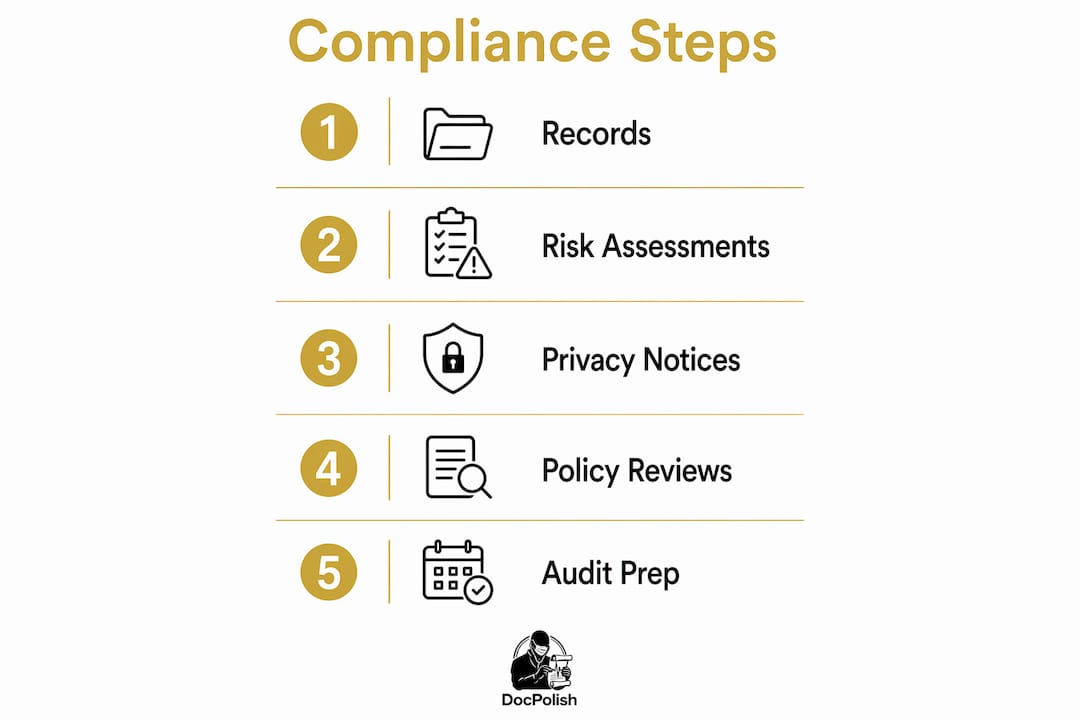
A complete data compliance checklist starts with your Records of Processing Activities. Article 30 of GDPR requires controllers and processors to maintain records covering eight elements: controller and DPO contact details, processing purposes, data subject categories, recipient categories, third-country transfers, retention periods, and a description of security measures. Each element must be present and current. A RoPA that lists purposes without retention periods will fail an audit.

Processor and vendor documentation sits alongside the RoPA. Article 28 compliance requires signed Data Processing Agreements, documented processing instructions, evidence of security controls, breach support procedures, and records of sub-processor approvals. A signed contract alone is not sufficient. Regulators expect an evidence pack that demonstrates processors actually operate as agreed.
Privacy-facing documents form the third pillar. Your checklist must include:
- A published Privacy Notice covering lawful basis, retention, and data subject rights
- A Data Subject Access Request procedure with response timelines
- Consent records where consent is the lawful basis, including withdrawal mechanisms
- Cookie policies aligned to current ePrivacy guidance
Security and risk documentation completes the picture. Data Protection Impact Assessments are mandatory for high-risk processing activities. Your checklist must record which processing activities triggered a DPIA, the outcome, and any residual risks accepted by management.
For organisations subject to HIPAA, documentation requirements include a Notice of Privacy Practices, Business Associate Agreements, and all supporting policies and procedures. HIPAA mandates that these records are retained for at least six years. That retention rule applies to the policies themselves, not just the data they govern.
Pro Tip: Treat your RoPA as a living inventory, not a one-off exercise. Link each record directly to the processing activity it describes, so updates happen automatically when operations change.
How to implement a phased approach to building your compliance documentation
Building a complete documentation framework from scratch is manageable when broken into phases. GDPR compliance implementation follows a logical four-phase structure that takes approximately 12 weeks to complete, followed by ongoing maintenance.
-
Foundation (weeks 1–3). Appoint a Data Protection Officer or compliance lead. Conduct a data inventory to identify all personal data flows. Map lawful bases to each processing activity. This phase produces the first draft of your RoPA and establishes the governance structure everything else depends on.
-
Rights and notices (weeks 4–6). Draft and publish your Privacy Notice. Build your DSAR procedure and test it against the one-month response deadline. Review all processor relationships and issue or update Data Processing Agreements. Audit consent mechanisms and document withdrawal options.
-
Security and breach management (weeks 7–9). Document your technical and organisational security measures. Identify processing activities that require a DPIA and complete them. Establish a breach notification workflow with clear roles, timelines, and escalation paths. Deliver staff training and record attendance.
-
Governance and maintenance (weeks 10–12 and ongoing). Schedule quarterly compliance reviews. Assign document owners for each policy and record. Set update triggers, such as new processing activities, system changes, or regulatory guidance updates. Integrate HIPAA documentation audits into the same review cycle where applicable.
Integrating HIPAA timelines into this framework requires one additional step. Business Associate Agreements must be in place before any data sharing begins, not retrospectively. Build BAA execution into your vendor onboarding process so it becomes a gate, not an afterthought.
Pro Tip: Set calendar reminders for annual policy reviews tied to your organisation’s financial year. Compliance documentation that drifts out of date is the single most common cause of avoidable audit findings.
What are common compliance documentation pitfalls and how to avoid them?
The most damaging documentation failures are not dramatic. They are mundane. Stale or undated policies are among the most frequent causes of audit failure under both HIPAA and GDPR. A policy without an effective date and a version number is unenforceable as evidence.
Common pitfalls compliance officers encounter include:
- Undated records. Every document must carry a creation date, a review date, and a version number. Regulators need to establish which policy was active at the time of an incident.
- Missing version history. Overwriting old versions without archiving them destroys the audit trail. Use a document control system that preserves prior versions.
- Superficial DPIAs. A DPIA that identifies risks but contains no mitigation actions or management sign-off is worse than no DPIA. It demonstrates awareness of risk without response.
- Processor evidence gaps. Operational proof of compliance from processors, such as penetration test results, ISO 27001 certificates, and incident response records, must be stored alongside signed agreements. Contracts alone do not satisfy Article 28.
- No ownership assigned. Documents without a named owner are never updated. Assign a specific individual, not a team or department, to each policy and record.
“GDPR compliance is accountability evidence-based, not just policy possession.” — GDPR compliance insight
The trigger problem is particularly common in fast-moving organisations. A new product launch, a change of cloud provider, or an acquisition all require RoPA updates and potentially new DPIAs. Without a formal change management process that flags these triggers to the compliance team, documentation falls behind operations.
Which tools and practices support data handler compliance documentation?
The right tools reduce the manual effort of maintaining a document management compliance framework without reducing its rigour. The table below compares the main categories of tool used by compliance teams.
| Tool category | Primary function | Best suited for |
|---|---|---|
| Data mapping software | Automates discovery and cataloguing of personal data flows | Building and updating the RoPA |
| Document control platforms | Version control, approval workflows, audit trails | Policy and procedure management |
| Checklist template libraries | Pre-built frameworks aligned to GDPR and HIPAA | Initial compliance gap analysis |
| AI document refinement tools | Polishing and quality-checking compliance documents | Drafting notices, policies, and procedures |
| Training management systems | Recording staff training completion and dates | Demonstrating staff awareness obligations |
Checklist templates from sources such as Vision Compliance and Sorena provide a useful starting point for gap analysis. They map requirements to specific GDPR articles and HIPAA provisions, which saves significant research time. The risk is treating a template as a finished product. Templates must be adapted to your organisation’s actual processing activities.
RoPA records should be audit-ready artefacts, not pointers to other policies. Each record must stand alone as evidence of the processing activity it describes. Linking a RoPA entry to a policy document that itself requires interpretation creates ambiguity that regulators will exploit.
Docpolish addresses a specific gap in the compliance documentation workflow. When drafting or refining sensitive documents such as privacy notices, DPIAs, or data handler guidelines, compliance officers often use AI writing tools that transmit document content to external servers. Docpolish detects and anonymises personally identifiable information on the client side before any content leaves the browser. The original PII is restored in the final output. Every processed document receives a trust identifier, creating an audit trail that supports confidential document editing practices required in regulated industries.
Pro Tip: Link every documentation tool to a named document owner. Software does not maintain compliance records. People do. The tool is only as current as the person responsible for it.
How to ensure ongoing governance and audit readiness
Ongoing governance is what separates organisations that pass audits from those that scramble before them. Scheduled reviews and DPO oversight are integral to sustained compliance, not optional extras.
A practical governance cycle for data handler compliance documentation looks like this:
-
Monthly. Review any new processing activities or system changes. Update the RoPA and assess whether a DPIA is required. Confirm that all new processor relationships have signed DPAs in place.
-
Quarterly. Audit a sample of processor evidence packs. Verify that security certificates and penetration test results are current. Check that DSAR response logs are within the one-month deadline and that any extensions are documented.
-
Annually. Conduct a full compliance documentation review. Update all policies with new effective dates and version numbers. Deliver refresher staff training and record completion. Review the DPIA register and update any assessments where the underlying processing has changed.
-
Event-triggered. Any data breach, regulatory change, or significant operational change must trigger an immediate documentation review. Breach notification workflows must be tested at least annually to confirm they function as documented.
Version control is non-negotiable for audit readiness. Every document must carry its version number, the date it was approved, the name of the approver, and the date of the next scheduled review. Policy version control and risk analysis quality are the two factors that most directly determine audit outcomes. Regulators look for evidence that the organisation understood its risks at a specific point in time and acted accordingly.
Management commitment must be visible in the documentation itself. Escalation paths, sign-off records, and board-level data protection reports all demonstrate that compliance is governed from the top, not delegated entirely to a single compliance officer.
Key takeaways
A data handler document compliance checklist is only effective when every record is dated, owned, and linked to actual processing activities rather than abstract policy statements.
| Point | Details |
|---|---|
| RoPA must meet Article 30 | Include all eight required elements: purposes, categories, recipients, transfers, retention, and security measures. |
| Processor evidence goes beyond contracts | Store signed DPAs alongside operational proof such as security certificates and breach runbooks. |
| Phased implementation works | Build your documentation framework across four phases over 12 weeks, then maintain it through a scheduled governance cycle. |
| Version control prevents audit failure | Every policy needs a creation date, version number, approver name, and next review date to be enforceable as evidence. |
| HIPAA retention is six years minimum | Policies and procedures must be retained for at least six years, not just the personal data they govern. |
Why compliance documentation is harder than it looks
The compliance documentation frameworks that actually hold up under regulatory scrutiny share one characteristic: they were built by people who treated them as operational tools, not filing exercises. I have seen organisations with beautifully formatted policy libraries that collapse the moment a regulator asks a simple question, such as which version of the breach procedure was active on a specific date. The answer was not in the document. It was not anywhere.
The vendor management piece is where most compliance officers underestimate the work. Collecting a signed DPA feels like completion. It is not. The real obligation is maintaining evidence that the processor operates as the contract requires. That means chasing annual security certifications, reviewing sub-processor change notifications, and testing breach notification runbooks with your processors, not just internally. Most organisations do none of this consistently.
The practical lesson I keep returning to is that compliance documentation is a governance discipline, not a documentation project. The checklist is the starting point. The governance cycle is what keeps it alive. Incremental improvements, such as adding a version number field to every template or assigning a named owner to each record, compound over time into a genuinely audit-ready framework. Start with the gaps that would cause the most damage in an audit and work outward from there.
How Docpolish supports your compliance documentation workflow
Compliance officers in regulated industries face a specific problem when using AI tools to draft or refine sensitive documents. Most AI writing tools transmit full document content to external servers, creating a data protection risk in the very process of producing compliance documentation.
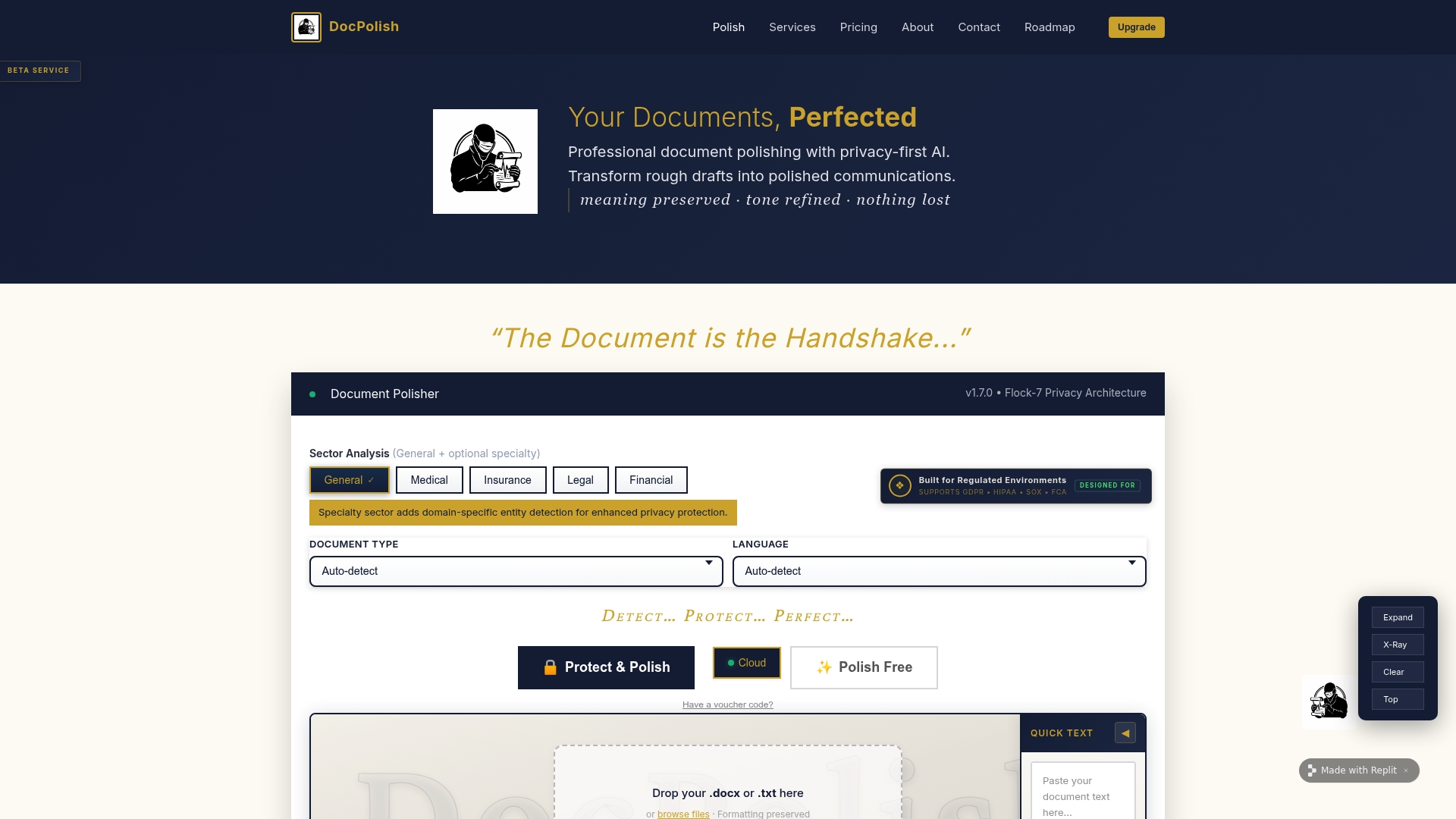
Docpolish resolves this by detecting and anonymising PII on the client side before any content is processed. Sensitive data never leaves the browser. After the AI engine refines the document, the original PII is restored in the final output. Every document receives a trust identifier, giving compliance teams a verifiable audit trail for documents processed under GDPR and HIPAA obligations. For teams drafting privacy notices, DPIAs, or data handler guidelines, Docpolish provides the quality assurance of AI refinement without the compliance risk of external data exposure.
FAQ
What is a data handler document compliance checklist?
A data handler document compliance checklist is a structured record of all documentation, policies, and controls an organisation must maintain to meet data protection regulations such as GDPR and HIPAA. It covers records of processing activities, processor agreements, privacy notices, security measures, and breach procedures.
What does Article 30 of GDPR require?
Article 30 requires controllers and processors to maintain records of processing activities covering eight elements, including purposes, data categories, recipients, retention periods, and security measures. These records must be made available to supervisory authorities on request.
How long must HIPAA compliance documents be retained?
HIPAA requires that policies, procedures, and related documentation are retained for a minimum of six years from the date of creation or the date they were last in effect, whichever is later.
What is the most common cause of compliance audit failure?
Undated or stale policies are among the most frequent causes of audit failure under both GDPR and HIPAA. Regulators need to establish which policy was active at the time of an incident, and undated documents cannot provide that evidence.
Do processor contracts satisfy Article 28 on their own?
No. Article 28 compliance requires operational evidence alongside signed contracts, including security control documentation, breach response procedures, and sub-processor approval records. A signed agreement without supporting evidence does not satisfy the regulation.