Privacy by design document polishing process: 2026 guide
A privacy by design document polishing process is a systematic method that embeds privacy principles into every stage of document creation, review, and maintenance to ensure ongoing regulatory compliance. Under UK GDPR and EDPB guidance, Privacy by Design is a mandatory continuous duty, not an optional best practice. Organisations in healthcare, legal, and finance that treat document polishing as a one-off exercise risk fundamental rights infringements and failed audits. The standard industry term is “data protection by design and by default,” defined in Article 25 of UK GDPR. This guide uses both terms throughout, as practitioners encounter each in regulatory correspondence.
What does the privacy by design document polishing process require?
The privacy by design document polishing process requires three things working together: role-based accountability, technical controls, and repeatable checkpoints tied to your document lifecycle. Without all three, documents become stale, evidence trails break down, and auditors find gaps.
Privacy governance is multi-role: product teams own user-facing defaults, engineering teams own technical controls, and compliance teams maintain audit trails. That division matters because no single team sees the full picture. A compliance officer who writes a privacy policy without input from engineering will miss the pseudonymisation gaps that create real liability.

The ICO specifies seven key principles that a polished document must operationalise, including purpose limitation, data minimisation, and storage limitation. Each principle requires both a written statement and a corresponding technical or organisational measure. Stating “we collect only what is necessary” in a policy document means nothing without a data classification scheme that enforces it.
Proactive privacy measures that anticipate risks during the design phase reduce costly retroactive fixes. The EDPB is explicit: Privacy by Design is a mandatory duty. Organisations that wait until a product launches to polish their privacy documentation face the most expensive remediation work.
Prerequisites: tools and roles before you start
Before running any document review process, assign clear ownership across three functions:
- Product team: responsible for user-facing consent flows, default privacy settings, and notice accuracy
- Engineering team: responsible for pseudonymisation, access controls, controlled logging, and data deletion mechanisms
- Compliance team: responsible for maintaining the evidence trail, scheduling reviews, and liaising with the ICO if required
Beyond roles, you need four practical tools in place:
- A data flow map showing every category of personal data, its source, its purpose, and its retention period
- A privacy impact assessment (PIA) template aligned with ICO guidance, ready to trigger when risk indicators appear
- A data classification scheme that labels data by sensitivity and applies automated controls to routine categories
- An evidence register that timestamps decisions, approvals, and document versions against release cycles
Pro Tip: Embed your privacy checklist directly into your existing architecture review template or vendor onboarding form. Teams complete it as part of work they already do, rather than as a separate compliance task.
How to run the document polishing process step by step
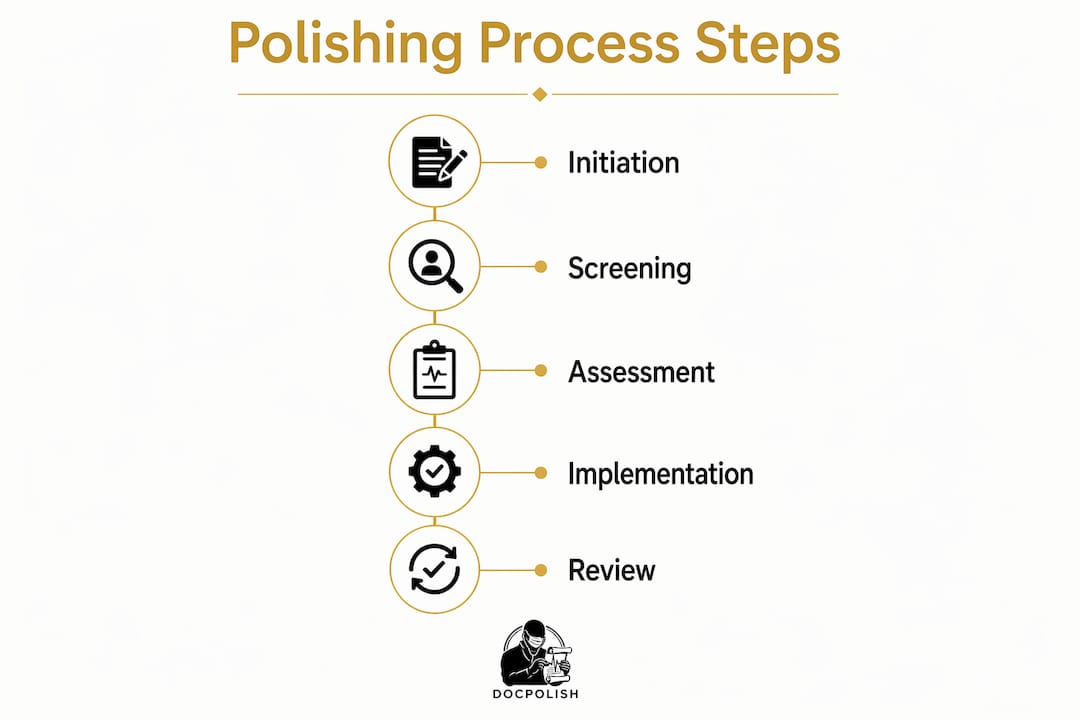
A structured document review process runs at four defined points: project initiation, design sign-off, pre-launch, and post-launch change. Each point has a specific set of questions and outputs.
-
Screening at project initiation. Ask six core questions: Does this project collect new personal data? Does it change the purpose of existing data? Does it change who can access data? Does it involve a new vendor? Does it require a notice update? Does it affect deletion mechanisms? A “yes” to any question triggers a full PIA. A lightweight checklist covering these six questions prevents teams from bypassing the process under time pressure.
-
Full PIA when risk indicators appear. The PIA documents the nature of the risk, the mitigation chosen, the owner of that mitigation, and the deadline. It is not a theoretical exercise. Each mitigation must map to a specific technical control or organisational measure already in your prerequisites toolkit.
-
Linked evidence records at pre-launch. Evidence records linked to release cycles, including decision ownership, approvals, and timestamps, are the single most important output of the polishing process. Regulators do not accept retrospective reconstruction. If you cannot show a timestamped record of the privacy decision made before launch, the decision effectively did not happen.
-
Reassessment when inputs change. Privacy assumptions expire when workflows, vendors, or data categories change. Schedule a reassessment trigger linked to system change events, not arbitrary calendar dates. A vendor contract renewal, a new AI feature, or a change in data residency each requires a fresh screening pass.
Pro Tip: Use your project management tool, whether Jira, Asana, or a similar platform, to create a standard privacy ticket type. Attach it to every feature ticket that involves personal data. This creates a natural evidence trail without additional administration.
| Stage | Trigger | Output |
|---|---|---|
| Project initiation | New project or feature involving personal data | Completed screening questionnaire |
| Design sign-off | PIA required based on screening | Documented risk mitigations with owners |
| Pre-launch | All mitigations confirmed | Timestamped evidence record linked to release |
| Post-launch change | Vendor, workflow, or data category change | Updated PIA and revised evidence record |
What are the most common pitfalls in privacy document polishing?
The most damaging misconception in privacy document polishing is treating it as a writing task rather than a technical and organisational constraint. Privacy by Design is a technical constraint embedded in systems architecture, covering pseudonymisation, controlled logging, and access control. A well-written policy that sits above a poorly architected system fails every audit.
Four pitfalls account for the majority of compliance failures in regulated industries:
- Treating documentation as the end product. Documents describe controls. If the controls do not exist in the system, the document is misleading. Regulators check both.
- Manual data tagging at scale. Manual tagging creates overdue reviews and stale records. Automated data classification handles routine categories and frees compliance teams to focus on high-risk processing.
- Uniform coverage of all data. Attempting to document every data point at the same depth creates an unmanageable workload. Focusing on 10–20% of high-risk processing activities, such as personally identifiable information in AI features, yields the greatest compliance impact.
- Single-role ownership. When only the compliance team owns privacy documentation, engineering gaps go undetected until an incident occurs. Multi-role accountability is not optional.
Privacy by design fails when it becomes a compliance team’s side project. It succeeds when product managers, engineers, and compliance officers each own a defined piece of the evidence chain.
Modern data protection strategies now prioritise data provenance and identity-based access control, because legacy perimeter defences no longer suffice. That shift has direct implications for document polishing: your evidence records must reflect where data originates and who accessed it, not just what your policy says about it.
How do you embed privacy checks without slowing delivery?
Recurring lightweight checkpoints integrated into existing SDLC tools keep documentation current without adding project overhead. Static compliance documents become obsolete within weeks of a product change. Integrated checks do not.
The practical approach has four components:
- Attach privacy tickets to feature work. Every feature ticket involving personal data gets a linked privacy ticket. The privacy ticket closes only when the evidence record is complete. This makes privacy a condition of delivery, not an afterthought.
- Assign per-feature privacy ownership. Each feature has a named privacy owner from the product or engineering team. That person is responsible for completing the screening questions and escalating to compliance when a PIA is required.
- Automate classification of routine data. Low-risk, well-understood data categories do not need manual review on every cycle. Automated classification handles them. Compliance teams review the exceptions and the high-risk categories.
- Trigger reviews from system events, not calendars. A quarterly privacy review scheduled in a calendar is almost always missed or treated as a formality. A review triggered by a vendor change or a new data category is specific, timely, and defensible.
Pro Tip: When onboarding a new vendor who will process personal data, run the screening questionnaire as part of the vendor approval workflow. This is the point at which privacy assumptions are freshest and easiest to document accurately. For guidance on handling identity documents in financial contexts, the KYC document handling guide covers privacy by design compliance in regulated financial sectors.
For teams managing safe document workflows in regulated environments, embedding these triggers into existing approval gates is the most reliable way to maintain compliance velocity.
Key takeaways
A privacy by design document polishing process succeeds only when role-based accountability, technical controls, and timestamped evidence records operate together across every stage of the document lifecycle.
| Point | Details |
|---|---|
| Privacy by Design is mandatory | UK GDPR Article 25 and EDPB guidance make data protection by design a legal duty, not a best practice. |
| Multi-role ownership is non-negotiable | Product, engineering, and compliance teams each own a defined part of the evidence chain. |
| Evidence records beat policy statements | Timestamped records linked to release cycles are what regulators examine; policies alone do not satisfy audit requirements. |
| Focus on high-risk processing first | Concentrating documentation effort on the highest-risk 10–20% of processing activities delivers the greatest compliance return. |
| Integrate checks into existing workflows | Lightweight checkpoints embedded in SDLC tools and vendor onboarding keep documentation current without slowing delivery. |
Privacy by design in practice: what I have learned
Most teams I have worked with arrive at privacy documentation from the wrong direction. They write the policy first and then try to retrofit the technical controls. That sequence produces documents that look complete and systems that are not. The audit fails not because the policy was poorly written, but because the evidence trail stops at the document and never reaches the architecture.
The teams that get this right treat Privacy by Design as a product requirement, not a compliance deliverable. They assign a privacy owner to each feature the same way they assign a developer. They close the privacy ticket before they close the release ticket. The documentation is a byproduct of that process, not the goal of it.
The other thing I have seen consistently is that organisations waste significant effort trying to document everything uniformly. The EDPB’s own guidance points toward proportionality. A patient record system processing sensitive health data warrants a full PIA and detailed evidence records. A staff directory with names and job titles does not. Treating both the same way exhausts compliance teams and produces documents that nobody reads.
The most audit-ready organisations I have encountered share one habit: they link every privacy decision to a release. Not to a quarter, not to a policy version, but to a specific release with a specific date and a named approver. When a regulator asks what privacy assessment was conducted before a feature went live, they can answer in under five minutes. That speed is not luck. It is the result of building evidence creation into the delivery process from the start.
How Docpolish supports privacy-compliant document polishing
Regulated industries face a specific challenge: documents containing personally identifiable information need professional polishing, but sending raw PII to an external AI engine creates an immediate compliance risk.
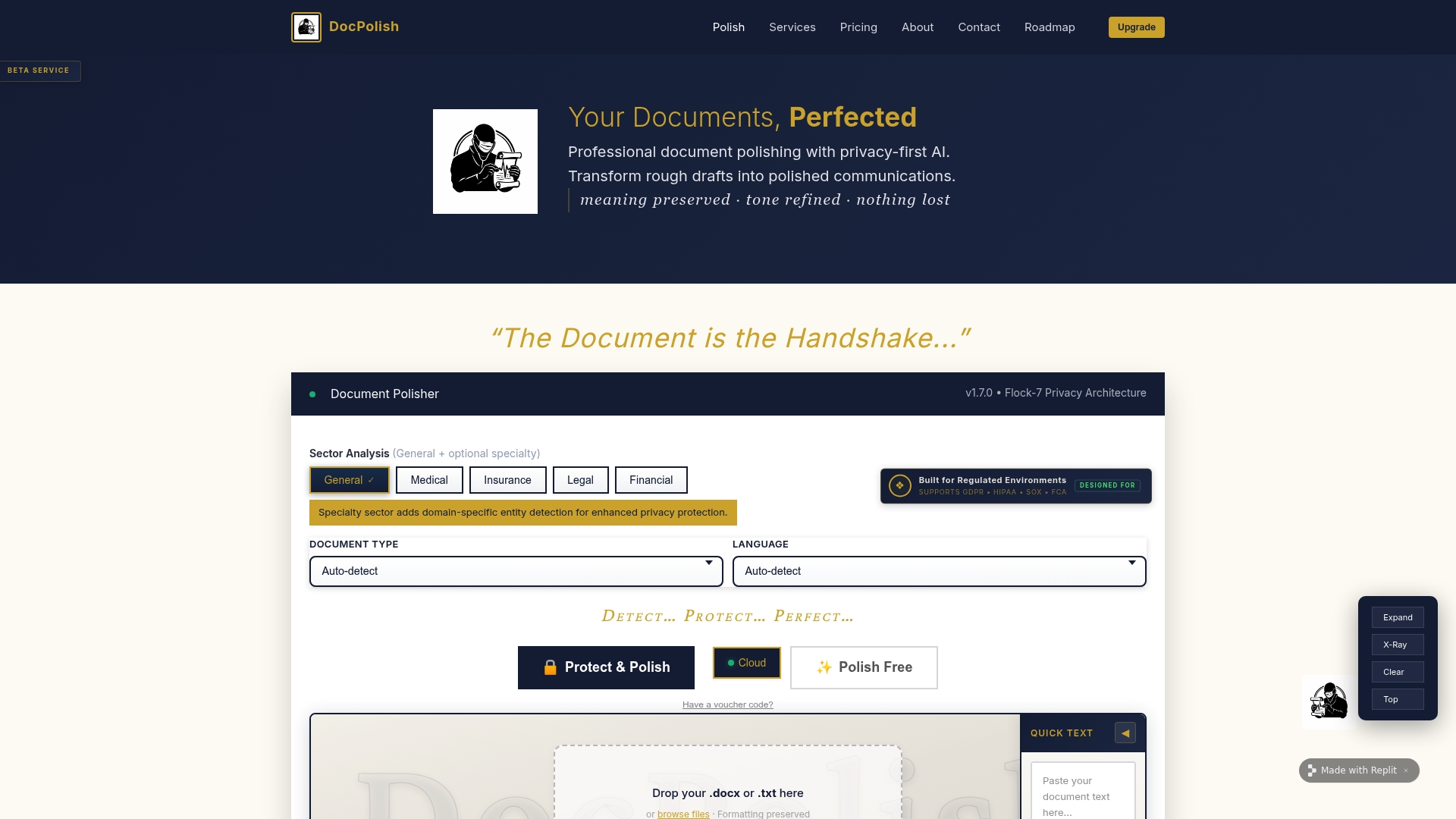
Docpolish addresses this directly. Its client-side detection and anonymisation process ensures that PII never leaves the user’s browser. The document is anonymised before it reaches the AI polishing engine, and the original PII is restored in the final output. Every processed document receives a trust identifier, creating an audit trail that supports your evidence records. For teams working through the legal document drafting workflow or managing sensitive healthcare records, Docpolish provides the privacy-first architecture that Article 25 requires. Visit the Docpolish platform to see how it fits your compliance workflow.
FAQ
What is the privacy by design document polishing process?
The privacy by design document polishing process is a structured method for reviewing and updating documents to embed data protection principles, including purpose limitation and data minimisation, at every stage of the document lifecycle. It combines role-based accountability, technical controls, and timestamped evidence records to meet UK GDPR Article 25 requirements.
When is a privacy impact assessment required during document polishing?
A PIA is required whenever a screening questionnaire identifies a risk indicator, such as new personal data collection, a change in data purpose, a new vendor, or a change in access controls. The ICO recommends triggering PIAs at the design stage, before processing begins.
How do you keep privacy documents current without slowing delivery?
Integrate lightweight screening checklists into existing workflows such as architecture reviews and vendor onboarding, and trigger reassessments from system change events rather than fixed calendar dates. This approach, recommended by privacy by design guidelines, keeps documentation current without adding separate compliance overhead.
What evidence do regulators expect from a privacy by design process?
Regulators expect timestamped evidence records linked to specific release cycles, showing the privacy decision made, the owner of that decision, and the approvals obtained before deployment. Retrospective reconstruction of these records is not accepted as evidence of due diligence.
How does Docpolish support privacy by design compliance?
Docpolish detects and anonymises PII on the client side before any document reaches an AI polishing engine, ensuring sensitive data never leaves the user’s browser. Each processed document receives a trust identifier, supporting the audit trail that privacy by design compliance requires.