Why accounting records contain sensitive PII: 2026 guide
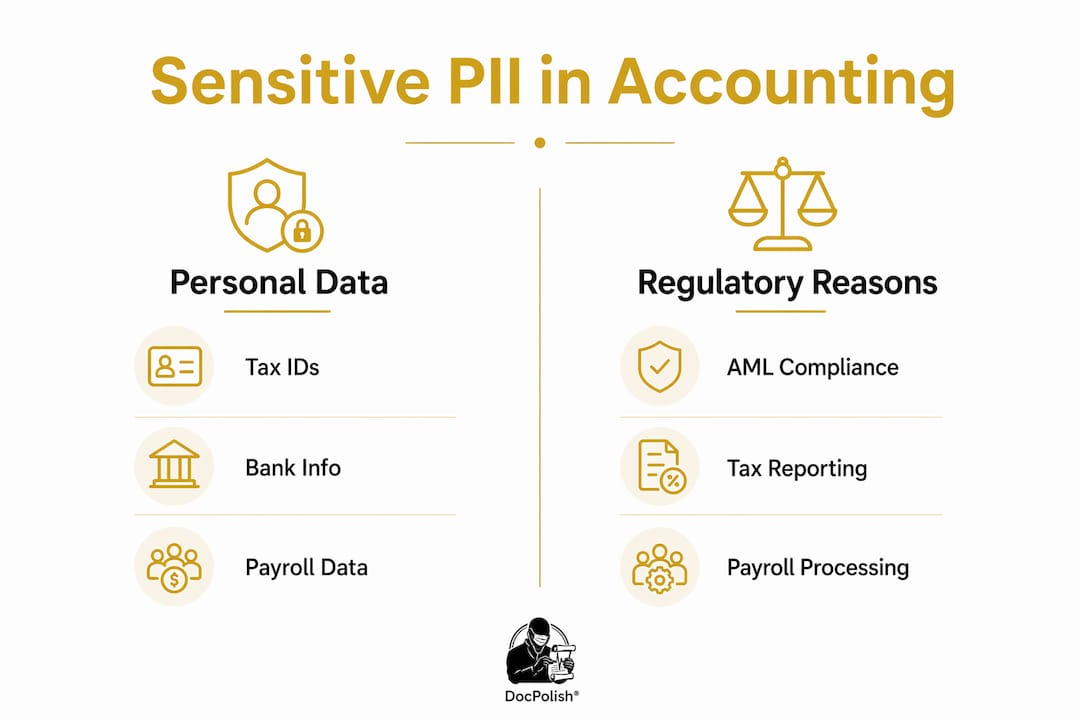
Accounting records contain sensitive personally identifiable information, known in the industry as PII, because they legally and operationally must include comprehensive personal and financial details about individuals. Tax filings require national insurance numbers and tax identifiers. Anti-Money Laundering checks demand identity documents and bank statements. Payroll processing captures salary figures, bank account details, and employment data. Every one of these data points falls under the definition of regulated personal information under frameworks such as GDPR, POPIA, and the FTC Safeguards Rule. Understanding why accounting records contain sensitive PII is not an academic exercise. It is the foundation of every compliance decision your firm makes.
Why do accounting records contain sensitive PII?
Accounting records are saturated with sensitive PII because firms must collect comprehensive datasets to meet regulatory obligations such as AML checks and tax filings. These obligations are not optional. They are imposed by statute, and failure to collect the required data can result in regulatory penalties or criminal liability.
The term “sensitive PII” refers to personally identifiable information whose exposure creates a meaningful risk of harm to the individual. In accounting, that includes data categories such as tax identifiers, payroll figures, bank account numbers, national insurance numbers, and copies of identity documents. Each of these can be used to identify, locate, or financially harm a specific person. That is precisely why regulators treat them differently from less sensitive business data.

The distinction matters because accounting firms often handle both corporate data and individual data simultaneously. A payroll file, for example, contains the employer’s financial records and each employee’s personal earnings, tax deductions, and bank details. Both categories carry legal obligations, but the individual data carries additional privacy rights under GDPR and equivalent frameworks.
What categories of sensitive PII appear in accounting records?
The table below maps the most common PII categories found in accounting records to the regulatory or operational reason they are collected.
| PII category | Why it is collected | Governing framework |
|---|---|---|
| Tax identifiers (UTR, NI number) | Required for tax filings and HMRC reporting | HMRC, GDPR |
| Bank account details | Payroll processing and supplier payments | AML Regulations 2017 |
| Identity documents (passport, driving licence) | Client verification and AML due diligence | Money Laundering Regulations |
| Payroll data (salary, deductions) | Accurate payroll and statutory reporting | Employment Rights Act, GDPR |
| Beneficial ownership information | Corporate transparency and AML compliance | Companies Act, FATF standards |
Several principles govern how this data should be handled once collected.
- Data minimisation: Collect only what is strictly necessary for the stated purpose.
- Purpose limitation: Do not use payroll data for marketing or client profiling.
- Storage limitation: Tax authorities mandate retention periods of up to 5–7 years. Records held beyond that require a lawful justification or must be securely disposed of.
- Accuracy: Out-of-date personal data creates both compliance risk and operational errors.
The retention point deserves emphasis. Many firms retain accounting records beyond lawful periods, creating what practitioners call a “retention gap.” This gap violates GDPR’s accountability principle and increases the firm’s exposure in the event of a breach.
Pro Tip: Implement an automated deletion policy for records that have passed their mandated retention period. Dark data, records you no longer need but still hold, carries the same breach risk as active data.
How do regulatory frameworks shape PII handling in accounting?
Accounting firms operate under a layered set of privacy and security obligations. GDPR applies to any firm processing the personal data of individuals in the UK or EU. POPIA applies to firms operating in or with South Africa. The FTC Safeguards Rule applies to firms in the United States that handle consumer financial data.
The FTC Safeguards Rule is particularly significant because it classifies accounting firms as financial institutions. That classification triggers specific technical requirements, including encryption of nonpublic personal information and mandatory Multi-Factor Authentication on any system that accesses client data. Penalties for non-compliance can reach up to $50,120 per violation per day. That figure makes the cost of a weak security programme very concrete.
Key obligations across these frameworks include:
- Encryption at rest and in transit for all files containing personal data.
- Multi-Factor Authentication on accounting software, cloud storage, and email systems.
- Written Information Security Plan (WISP): A documented security programme that regulators such as the IRS and FTC expect to be 25–45 pages in length.
- Incident response protocols: Documented procedures for detecting, containing, and reporting data breaches to the relevant authority.
- Secure disposal: Physical and digital records must be destroyed in a way that prevents reconstruction.
Pro Tip: A static WISP filed once and forgotten does not satisfy regulatory expectations. The FTC and IRS expect a living, updated document that reflects changes in your technology stack, staffing, and threat environment.
What risks arise from mishandling PII in accounting records?
The most common source of PII exposure in accounting is not a sophisticated cyberattack. It is an unsecured communication channel. Sending a payroll file via standard email, sharing a client’s bank statement through a messaging app, or attaching an unredacted invoice to a cloud-shared folder all create real exposure. Automated PII detection tools redact 60–70% of sensitive data, but 30–40% requires human oversight to prevent breaches. That gap is where most incidents originate.
A second risk is metadata leakage. A PDF that appears redacted may still contain the original text in its metadata layer. A spreadsheet shared externally may carry version history with personal data from earlier drafts. These are not hypothetical edge cases. They are documented failure modes that regulators have cited in enforcement actions.
A third risk is the confusion between confidentiality and privacy. Confidentiality focuses on protecting information from unauthorised disclosure. Privacy focuses on the individual’s rights over their own data. Accounting payroll data is both confidential corporate information and private individual data. Treating it only as confidential, without applying privacy controls such as access limitation and purpose restriction, leads to ineffective data governance.
Common pitfalls to avoid:
- Sharing client files via personal email accounts.
- Using generic folder permissions rather than role-based access controls.
- Retaining records past their mandated period without a documented lawful basis.
- Failing to audit third-party tools for their own data handling practices.
Pro Tip: Standard PII detection tools miss internal custom identifiers such as client codes and payroll IDs. Define custom entity types within your detection configuration to catch identifiers specific to your firm’s systems.
Best practices for protecting sensitive PII in accounting workflows
Effective protection of sensitive information in finance requires both technical controls and administrative discipline. Neither alone is sufficient.
Technical safeguards
Encryption is the baseline. All files containing personal data must be encrypted both at rest, on servers and local drives, and in transit, when sent between systems or to clients. Multi-Factor Authentication must be applied to every system that touches client data, including cloud accounting platforms, email, and document storage. Secure disposal means using certified data destruction for physical records and verified deletion for digital files, not simply moving them to a recycle bin.
Administrative controls
Data classification is the starting point. Every document type in your firm should carry a classification label, such as “restricted,” “confidential,” or “internal,” that determines who can access it and how it must be handled. Access reviews should be conducted at least annually. When a staff member changes role or leaves the firm, their access permissions must be revoked immediately.
Safe document workflows in regulated environments require that sensitive data never passes through uncontrolled channels. That means using encrypted portals for client file exchange, not email attachments.
The table below compares technical and administrative safeguards by function.
| Safeguard type | Example control | Primary risk addressed |
|---|---|---|
| Technical | Encryption at rest and in transit | Unauthorised data access |
| Technical | Multi-Factor Authentication | Credential theft and account takeover |
| Technical | Automated PII detection | Inadvertent disclosure in documents |
| Administrative | Data classification policy | Inconsistent handling of sensitive files |
| Administrative | Access reviews and role-based permissions | Insider risk and privilege creep |
| Administrative | WISP with documented training | Regulatory non-compliance |
Privacy governance is also expanding beyond static identifiers. Data appearing anonymised can be re-identified through linkage with other datasets. Job titles, hire dates, and postcode data, when combined, can identify an individual even without a name attached. Effective risk management treats these quasi-identifiers as PII and audits data flows accordingly. Docpolish addresses this challenge directly by detecting and anonymising PII at the client side before any document is processed, ensuring sensitive data never leaves the user’s browser.
Key takeaways
Accounting records contain sensitive PII because regulatory frameworks, including GDPR, AML regulations, and the FTC Safeguards Rule, legally require firms to collect, retain, and process detailed personal and financial data about identifiable individuals.
| Point | Details |
|---|---|
| PII is legally required in accounting | AML, tax, and payroll obligations mandate collection of identifiers, bank details, and identity documents. |
| Retention gaps increase breach risk | Records held beyond the 5–7 year mandated period create unnecessary exposure and GDPR liability. |
| Regulatory frameworks impose technical controls | GDPR, POPIA, and the FTC Safeguards Rule require encryption, MFA, and a documented WISP. |
| Automated detection has limits | Tools redact 60–70% of sensitive data; custom identifiers and quasi-identifiers require manual oversight. |
| Confidentiality and privacy are distinct obligations | Payroll data requires both corporate confidentiality controls and individual privacy rights management. |
The compliance gap nobody talks about
Most accounting firms I encounter have a WISP. Very few have a WISP that reflects how their firm actually operates today. The document was written two years ago, references software that has since been replaced, and has never been tested against a simulated incident. That is not compliance. That is paperwork.
The harder problem is cultural. Staff who handle sensitive client data every day stop seeing it as sensitive. A payroll spreadsheet becomes just another file. A client’s bank statement becomes just another attachment. That normalisation is where breaches begin, not in the server room, but in the habits of people who are not thinking about privacy because nobody has made it a live concern for them.
The firms that get this right treat privacy governance as an operational discipline, not a legal formality. They run quarterly access reviews. They test their incident response plan. They update their WISP when they adopt a new cloud tool. They train staff not once at onboarding but repeatedly, with scenarios drawn from real breach cases. The importance of PII in accounting is not abstract. It becomes concrete the first time a client’s data appears somewhere it should not.
The other thing I would push back on is the assumption that technology solves this. Automated detection tools are genuinely useful, but they are not a substitute for governance. A tool that catches 70% of sensitive data and leaves the rest to chance is not a compliance programme. It is a starting point. The firms that combine automated detection with clear policies, trained staff, and regular audits are the ones that avoid the enforcement actions you read about in the trade press.
How Docpolish supports secure accounting document workflows
Accounting firms process a high volume of documents containing sensitive personal and financial data every day. Each document that passes through an external tool or AI system creates a potential exposure point.
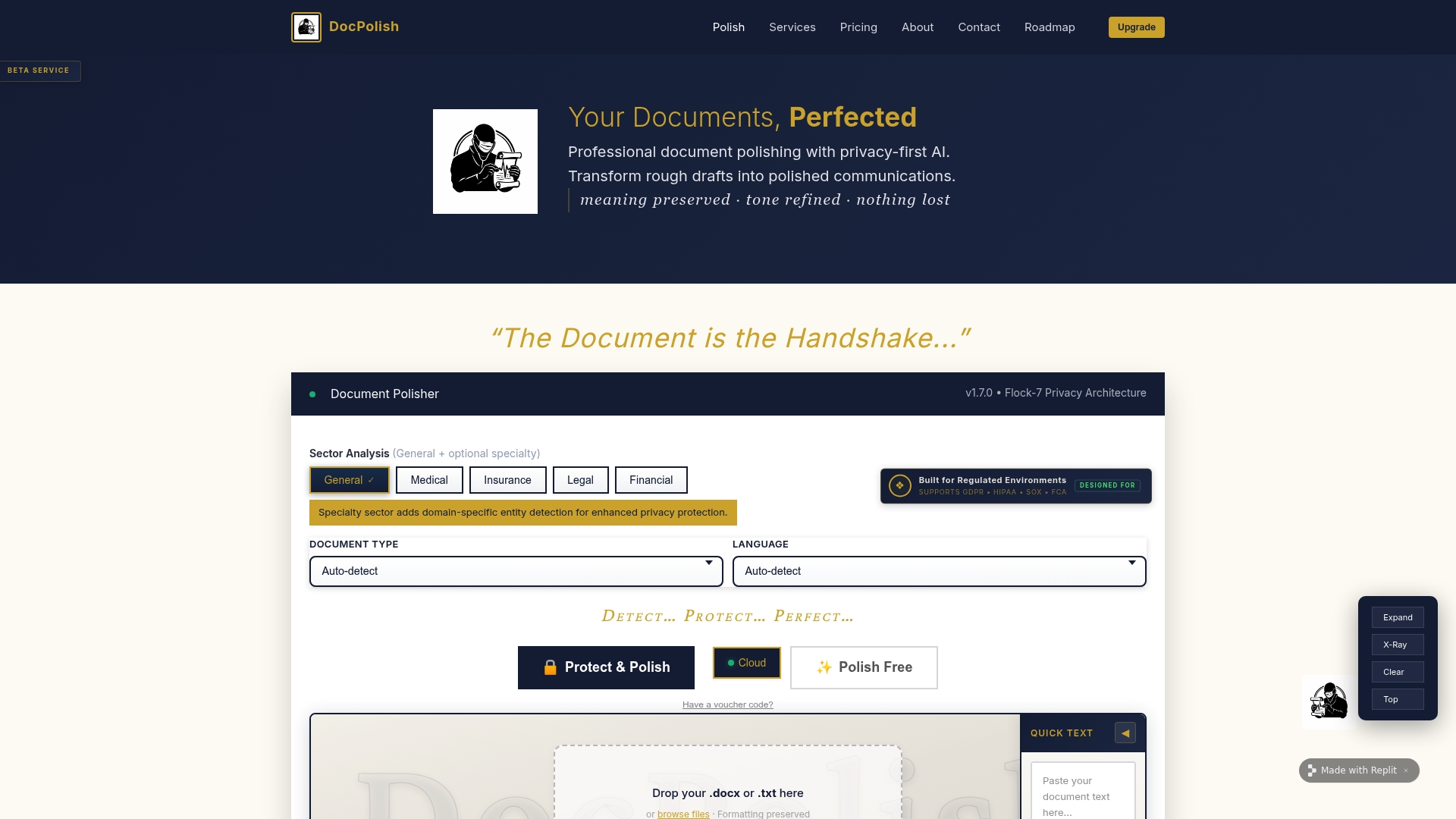
Docpolish is built specifically for regulated industries where that exposure is unacceptable. Its client-side PII detection identifies and anonymises sensitive data before any document leaves the user’s browser. The AI engine then refines the document, and the original PII is restored in the final output. No sensitive data touches an external server. Every processed document receives a trust identifier, creating an audit trail that supports GDPR and HIPAA compliance. For accounting firms that need to handle sensitive documents securely while maintaining professional document quality, Docpolish provides a privacy-first workflow that fits directly into existing compliance programmes.
FAQ
What is sensitive PII in accounting records?
Sensitive PII in accounting records includes tax identifiers, bank account details, payroll data, national insurance numbers, and identity documents. These data points can identify and financially harm individuals, which is why GDPR and AML regulations treat them as regulated personal information.
How long must accounting firms retain records containing PII?
Tax authorities typically mandate retention periods of 5–7 years for accounting records. Records held beyond that period require a documented lawful basis under GDPR, or they must be securely disposed of to avoid a retention gap.
What is a WISP and why does accounting need one?
A Written Information Security Plan is a documented security programme required by the FTC Safeguards Rule for firms classified as financial institutions, including accounting practices. It must cover encryption, Multi-Factor Authentication, incident response, and staff training, and must be updated regularly to reflect changes in technology and data flows.
Why is protecting PII in accounting different from general data protection?
Accounting records combine corporate confidentiality obligations with individual privacy rights. Payroll data, for example, is both a business record and a private individual’s financial information, requiring separate access controls and purpose limitations that general data protection policies often do not address.
Can anonymised accounting data still pose a privacy risk?
Anonymised data can be re-identified when linked with other datasets. Quasi-identifiers such as job titles, hire dates, and location data can combine to identify an individual even without a name present. Effective PII governance in accounting must account for re-identification risk, not just static identifiers.